

Madman Puts Two Jet Engines On A Harley-Davidson And Creates Total Chaos
By Jared Solomon Courtesy HotCars
Most people look at a Harley-Davidson with its engine scattered across the floor and see an expensive pile of motorcycle-shaped scrap. One brilliantly unhinged builder looked at the same wreckage and decided it needed aviation technology.
What followed required more than 400 hours of fabrication, custom electronics, improvised fuel systems, and the sort of decision-making normally followed by the phrase “do not attempt this at home.” Somehow, the finished motorcycle does not resemble a garage experiment either. It looks like a solid build, and almost something believable that the folks at Harley-Davidson might even build... if its engineering department replaced coffee with rocket fuel.
This Harley-Davidson Was Already Completely Destroyed

The project began when Bikes and Beards supplied a non-running Harley-Davidson with a spectacularly ruined engine. Its pistons were sticking out of the crankcases, while the cylinder heads and cylinder walls had already left the party. Repairing the original engine would have been the sensible choice, so naturally it was removed entirely.
The transmission, clutch, and remaining internal components were stripped away, turning the six-speed Harley into a one-speed jet motorcycle. Two micro-turbine engines were then mounted where the once awesome America V-twin once lived. Together, they produce approximately 150 pounds of thrust and propel the bike using nothing but hot exhaust and questionable judgment.
The goal was not merely to strap turbines onto an old frame and hope everyone survived. The builder wanted the machine to look like a factory-produced jet Harley, complete with polished bodywork, neatly integrated components, and controls that operated like those on a regular motorcycle.
It Took 400 Hours To Make This Insanity Look Factory-Built
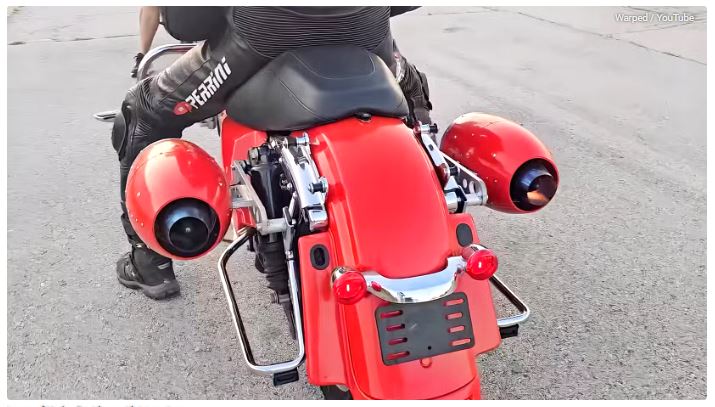
Custom containment covers were designed for the turbines to protect the rider in case something failed. The builder also hand-formed metal panels, fabricated a fuel tank and reserve system, installed an old-school mechanical fuel gauge, and created the electronics required to operate both engines.
Even the original Harley controls and display were incorporated into the system. Turn the ignition, move the switch into its run position, press the starter, and the two turbines begin spooling. It is wonderfully theatrical, although the sound probably causes every dog within three counties to go nuts.
Finishing the build took more than 400 hours. That included painting it in a modern Harley shade of red and making the conversion look surprisingly tidy. If Harley-Davidson actually offered a jet-powered model, this is probably what it would resemble... but only after the entire safety and legal department resigned.
This Twin-Jet Harley Is Far Scarier Than Expected
The first test began cautiously because nobody knew whether 150 pounds of thrust would move the heavy motorcycle effectively. It did. The builder reached approximately 45 mph while using only around one-quarter throttle and described the experience as unlike riding any conventional motorcycle.
There is no engine vibration, transmission shifting, or familiar surge of torque. Instead, the bike feels as though it is floating while an invisible giant steadily pushes it forward. That sounds peaceful until you remember two screaming turbines are firing superheated exhaust behind your legs.
A top-speed attempt was postponed because the builder was still wearing an external leg fixator while recovering from his injuries. Riding a jet-powered Harley with medical scaffolding attached to your body apparently crosses even his unusually generous definition of risky. Once the motorcycle was handed to Bikes and Beards, Sean took it to 60 mph and believed there was considerably more speed available. Another rider suggested it might have reached roughly 70 mph. That will not trouble a modern superbike, but speed feels slightly different when you are sitting above two jet engines built into a formerly dead Harley.
The project transformed a worthless chassis into one of the loudest and strangest motorcycles on the road. It may not sound like a Harley anymore, but it certainly preserves the company’s long tradition of making sure everyone hears you coming.